Decimal Odds Explained: A Tanzania Guide to Stakes and Returns
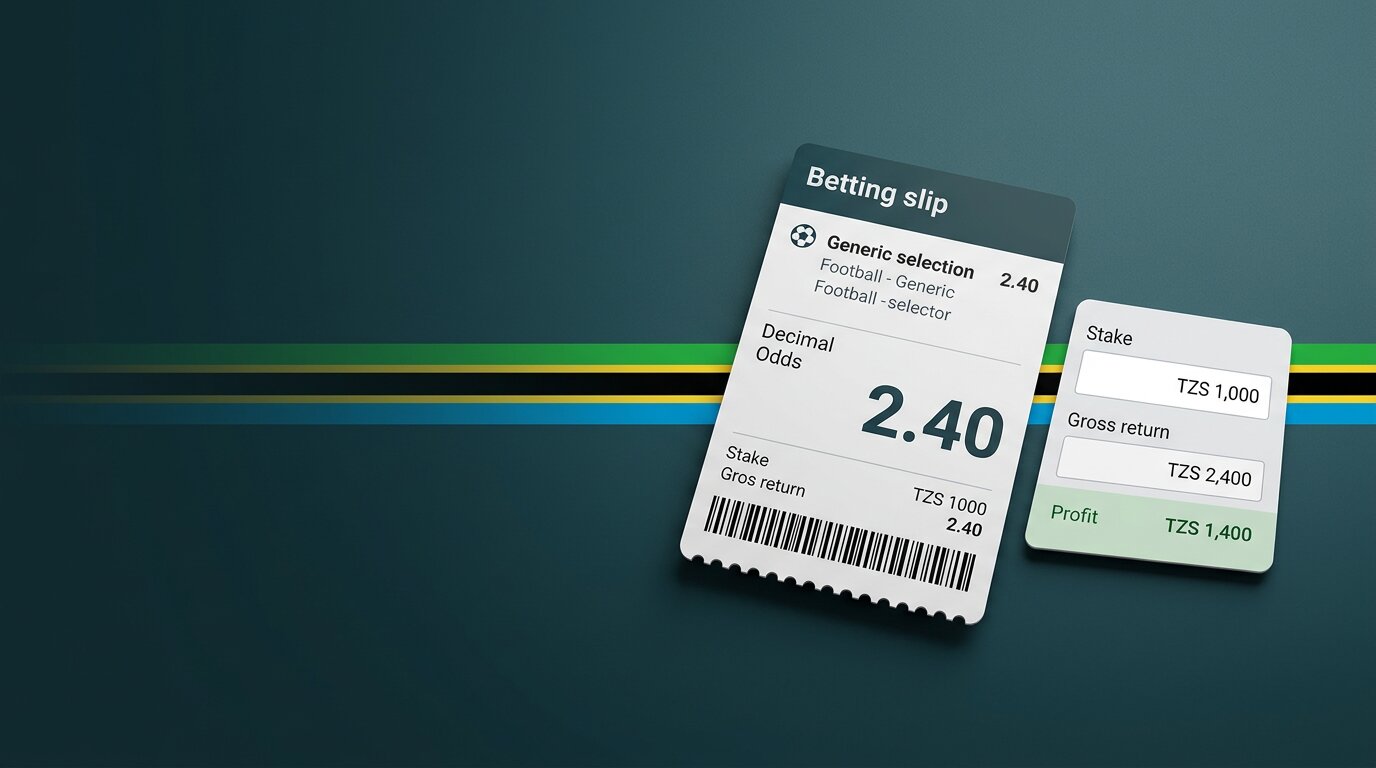
A bet slip showing “2.40” tells you how a winning bet is paid. It does not mean a TZS 1,000 stake earns TZS 2,400 in profit, and it does not establish the true chance that the selection will win.
Understanding that distinction makes a slip much easier to read. Start with three amounts: the stake you put at risk, the gross return if the bet wins and the profit left after subtracting the original stake.
Work through one slip
Suppose you place a TZS 1,000 single bet at decimal odds of 2.40. For an ordinary winning bet, multiply the stake by the odds: 1,000 × 2.40 = TZS 2,400.
That TZS 2,400 is the gross return. It already includes the TZS 1,000 stake. Subtract the stake and the profit is TZS 1,400.
If the selection loses, the return is zero and you lose the TZS 1,000 staked. The potential return displayed before the event is a conditional amount, not money you have earned or a forecast of what will happen.
This example assumes a standard cash single with no bonus conditions, tax deductions, fees or special settlement rules. Those can change the amount ultimately credited or available to withdraw.
A void is different from a loss. If an ordinary single is declared void and the full stake is refunded under the applicable rules, your TZS 1,000 comes back and the net result is zero. Do not count that refund as a winning bet when reviewing your results.
Confirm what you are betting on
Before using the calculation, read the market name. “Match result,” “to qualify” and “first-half result” do not describe the same outcome.
A team may draw during normal time and then advance on penalties. A normal-time win selection and a qualification selection would not be settled in the same way. The arithmetic can be correct while your understanding of the bet is wrong.
For readers learning how a slip fits into the wider process, these betting basics provide a starting point. Still read the specific market and settlement terms attached to the selection you are considering.
Compare prices without changing the question
Imagine the same outcome is offered at 2.40 and 2.50. At a TZS 1,000 stake, the possible gross returns are TZS 2,400 and TZS 2,500: a difference of TZS 100.
The higher price pays more if that selection wins. It does not make the event more likely to happen. Nor is it a fair comparison if one price covers normal time and the other includes extra time.
Prices can also move. Use the odds recorded on the accepted bet when checking its eventual return, not a price you remember seeing earlier.
Turn odds into a break-even percentage
Divide 100 by the decimal odds to calculate the implied probability. At 2.50, that is 40%. At 2.00, it is 50%.
One way to understand 40% is through ten equal TZS 1,000 bets, all at 2.50. Four wins would return TZS 10,000 against total stakes of TZS 10,000. Before deductions, that sequence breaks even.
This is an arithmetic illustration, not a prediction that four of your next ten bets will win. Outcomes can arrive in any order, and a small sample tells you little about a reliable long-term rate.
Why the percentages can add up to more than 100%
Consider a hypothetical three-way football market with home odds of 2.00, draw odds of 3.20 and away odds of 4.00.
Those prices imply 50%, 31.25% and 25%. Together they total 106.25%, although the three possible outcomes must share 100% of the actual probability.
The extra 6.25 percentage points are called the overround. They show that the quoted prices contain a margin; they are not three neutral estimates that can simply be read as true probabilities. The overround is also not a promise of the bookmaker's actual profit on that match.
Once you can separate payout arithmetic from probability, a slip becomes less mysterious. You can explain what a win would return, what a loss would cost and what the price does not tell you. None of those calculations removes the risk of losing the stake.